Top-rated independent appliance repair across the Midwest
Dryer Repair — Book a Visit Today
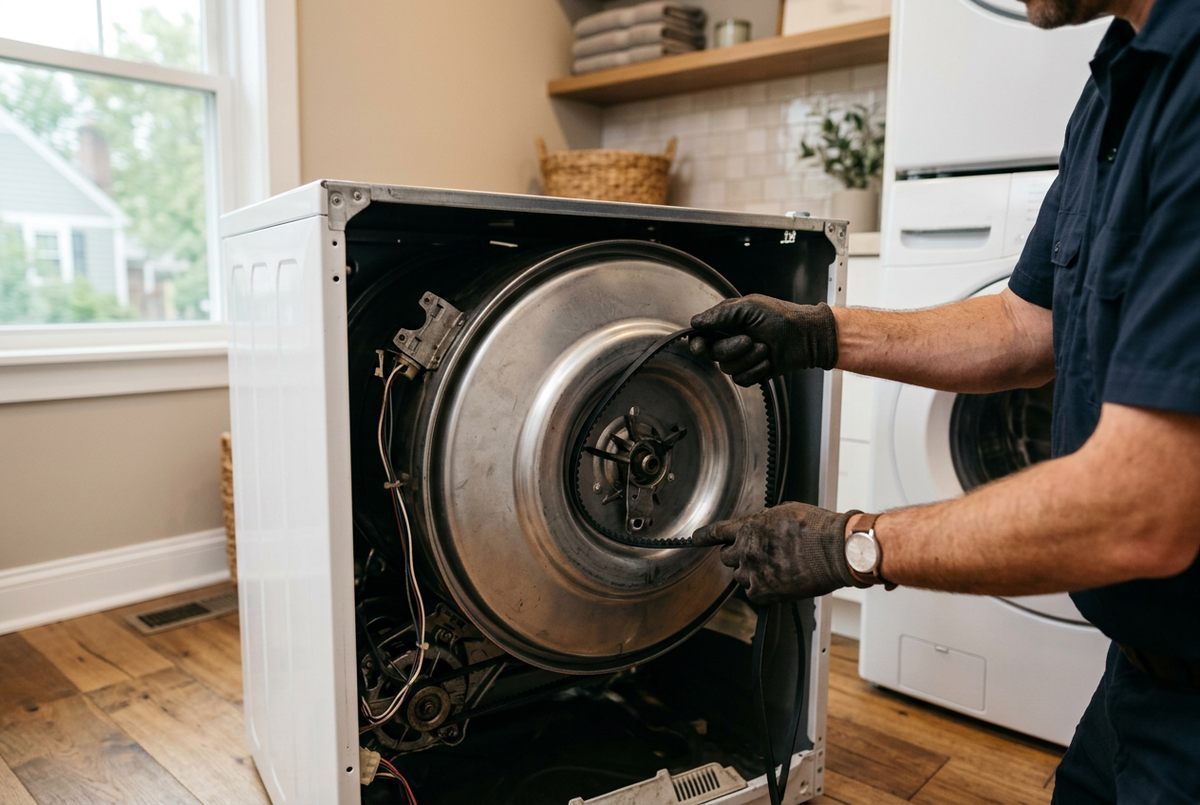
We repair gas and electric dryers, and the visit starts at the vent path because that one thing causes more service calls than any part inside the cabinet. After that we test the heat circuit, spin the drum by hand, and read the control board. Dryers fail in a handful of predictable ways. Heating elements and igniters burn out, thermal fuses trip after lint blocks the vent, belts snap, rollers flatten, and door switches quit sensing. So if your towels come out wet after a full cycle, or a basement laundry room smells like something is burning, or the drum hums without turning, we've seen it. Most repairs finish in one trip once we know the model. Tell us what you hear and smell when you call us, and we'll bring likely parts along.
Call (800) 967-1507- Real people on the phone
- 7 days a week
- Quote in writing before any work
Taking calls until 5:00 PM CT
The dryer symptoms we hear most
- "Clothes come out damp every time" Restricted venting, weak heat, or a failed moisture sensor
- "It runs but there's no heat at all" Blown thermal fuse, burnt heating element, or bad gas igniter/valve coil
- "Something's squealing and grinding" Worn drum rollers, dry idler pulley, or a scored rear bearing
- "Motor hums, drum won't move" Broken belt, seized pulley, or a motor with a bad start winding
- "Press start and nothing happens" Door switch, start switch, or control board and power supply fault
Safe things to check first
Worth a look before you call — sometimes it saves you the visit.
- 1Pull the lint screen and hold it under running water. If the water beads up on top, fabric softener film is choking your airflow.
- 2Step outside and watch the vent hood while the dryer runs; weak or no air movement means a blocked duct.
- 3Check that both halves of the 240-volt breaker are on, since half power gives you a tumbling drum with no heat.
- 4Open and shut the door firmly and listen for the switch click before deciding the machine is dead.
What homeowners get from an independent shop
| Steve's Appliance Repair | Big-box repair chains | Handyman listings | |
|---|---|---|---|
| Written quote before any work | ✓ | ✕ | ✕ |
| Phones answered by people, every day | ✓ | ✕ | ✓ |
| Every major brand, gas or electric | ✓ | ✓ | ✕ |
| No manufacturer targets to hit | ✓ | ✕ | ✓ |
| Crews familiar with homes like yours | ✓ | ✕ | ✓ |
After the visit, in their words
“No upsell talk at all. He fixed the drain pump and pointed out a hose I should watch, that was it.”
Jeff D.Clinton Township, MI“The scheduler actually listened to the symptoms and sent the guy with the right parts.”
Priya N.Lee's Summit, MO“Dishwasher stopped mid-cycle full of water. They walked me through draining it on the phone before the visit even happened.”
Carl H.Carmel, INDryer Repair — quick answers
Why does my dryer take three cycles to dry one load?
Airflow, almost always. Lint packs the duct, the vent hood flap sticks, or a long basement run sags and collects moisture. Weak heat from a partially failed element will do it too. We measure temperature rise and airflow to tell those two apart.
Is a burning smell an emergency?
Treat it that way. Stop the dryer, unplug it or shut the gas valve, and clear the lint screen area. Lint scorching against a hot element is a fire risk. Call us and let us inspect the cabinet and duct before you run another load.
Do you work on gas dryers as well as electric?
Yes. Gas units bring igniters, flame sensors, and valve coils into the picture, while electric units use elements and high-limit thermostats. Both share the same drum, belt, roller, and vent problems. Tell us which one you have when you call so we load the right parts.
My dryer stops mid-cycle and restarts later. What is that?
That pattern usually means a thermal cutoff or high-limit thermostat is opening on overheat, then resetting once things cool off. The root cause is nearly always restricted airflow. Replace the switch without clearing the vent and you'll see the same failure a week later.
Can I keep using it until you arrive?
If it only makes noise, short loads are usually fine. If you smell burning, see scorch marks, or the drum won't turn while the motor hums, leave it off. Forcing a seized dryer can damage the motor and turn a small repair into a big one.
How do I get ready for the appointment?
Clear a few feet in front of and behind the machine, empty the drum, and find the model number on the door frame or inside the door. If the laundry room sits in a tight basement corner, mention it. We plan the approach before we show up.
How it works
- Step 1
Tell us the symptom
Call us or fill out the form and describe what you hear, smell, or see. An error code helps. So does a puddle. We ask the brand and rough age so the van carries the parts we are likely to need.
- Step 2
We come look
Our technician tests the machine instead of guessing: water lines, heating elements, drain pumps, control boards. Then we explain what failed in plain words before any wrench turns.
- Step 3
Repair and clean up
Common parts ride with us, so a lot of repairs finish on that first visit. Special-order parts get scheduled right away. We run the cycle with you standing there, then haul off the old part and the packaging.
- A real person answers
- Open 7 days
- Written quote before work starts
Why homeowners call us
- Hard water is our specialtyMidwest water leaves scale on everything it touches. Crusted dishwasher spray arms. Clogged ice maker lines, and washers and water heaters full of mineral buildup. We know what that grit does to valves and seals, so we treat the cause instead of the symptom.
- Basement laundry roomsBasement setups fail differently than upstairs ones, between the long drain runs, the cold concrete, and lint packed into a vent that runs through the rim joist. We check the venting and the drain path too, not only the machine, so the same problem does not come back.
- Freeze-thaw season readyGarage freezers quit in January. Ice makers stop when the supply line freezes, and dryers labor when the vent hood ices over. Seasonal swings break appliances in fairly predictable ways, and those are the first things we look at on a winter call.
- Independent, all major brandsWe are not tied to any manufacturer, so we work on whatever is sitting in your kitchen or laundry room: refrigerators, ranges, dishwashers, washers, dryers, freezers. One shop, one call, whatever badge is on the door.
- All major brands, gas & electricIndependent service on Whirlpool, LG, Samsung, GE, Maytag, Bosch, KitchenAid and the rest.
- Straight answersIf it isn't worth repairing, we'll say so, often right on the phone.
Dryer Repair
Small faults become big ones on a schedule of their own
Describe the symptoms and we'll book the visit — takes about a minute.
- A real person answers
- Open 7 days
- Written quotes
- All major brands
- Gas & electric
Rather not call? Get a free quote →